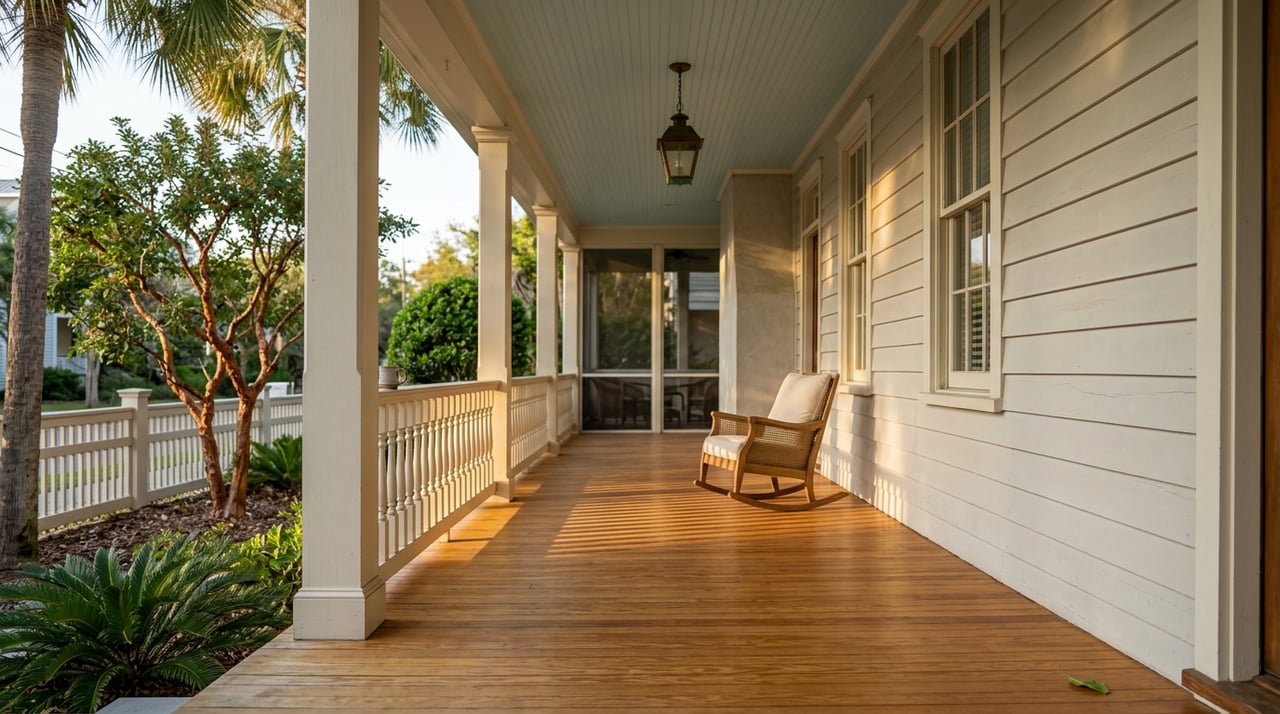
The COA Line: What Delray Beach Historic-District Buyers and Sellers Should Verify Before Signing
August 6, 2026
August 6, 2026
A contract on a house inside one of Delray Beach's five local historic districts is not the same instrument as a contract on a house one block outside. The lot may look identical on the plat. The list price may fall in the same bracket. But between the two, a procedural line runs through the transaction, and pricing on either side of that line follows different rules. This is the line the Historic Preservation Board draws when it decides whether a Certificate of Appropriateness is required, and it is where a surprising number of Delray deals quietly change shape.
The claim of this post is simple: inside the districts, the COA process, not the comp set, is doing most of the price discovery. Sellers who assume land-value pricing on a contributing structure often overprice. Buyers who assume renovation flexibility often overpay. The 2026 market is rewarding the ones who read the procedure first.
Delray's Historic Preservation Ordinance was adopted in March of 1987 to administer a survey that had already identified 270 historic structures inside the city. Today the local register includes five districts (Old School Square, Marina, Del-Ida Park, Nassau Park, and West Settlers) plus 26 individually designated properties ranging from residences and churches to museums and bridges.
If a property sits inside one of those districts or carries an individual designation, exterior work generally requires review. That includes the things most buyers assume are unregulated:
The board's own summary of its role is worth reading in the seller's language:
HPB's Certificate of Appropriateness (COA) review process can help guard against inappropriate new construction or exterior renovations in your neighborhood.
For a buyer whose spreadsheet assumes a fresh coat of paint and new windows on Day 30, that sentence is a scope-of-work clause with teeth.
The friction most agents miss on a district property is the demolition-delay mechanism written into the Land Development Regulations. For contributing structures inside a historic district, the board may hold the demolition question for up to 45 days. For individually designated city landmarks, the delay runs up to three months.
The delay is not the only lever. A COA for demolition cannot be issued in isolation. It must be paired with a concurrent application for new construction, and if approved, the demolition COA is only issued simultaneously with the new-construction COA upon receipt of reasonable proof that the owner is financially prepared to proceed. That proof can take the form of an irrevocable letter of credit, a payment or performance bond, or a commitment letter from a solvent bank or other lending institution. The board can also require concurrent consideration of relocation before it will deny a demolition request.
Translated into the closing table, this means a contributing structure is not a teardown priced at land value. It is a lot with a queue in front of it. The queue costs time (typically two Historic Preservation Board cycles at minimum for a full demolition-plus-rebuild package), and it costs an underwritten commitment to build. Sellers who market the property as "build your dream home" without disclosing the queue are pricing air. Buyers who plan to close, sit on the lot for two years, and then rebuild are pricing a call option the ordinance does not sell.
The cautionary case is the Sewell C. Biggs House at 212 Seabreeze Avenue, designed in 1955 by Paul Rudolph and listed on the Delray Beach Local Register of Historic Places. In 2018 the owners obtained a COA to remove two non-contributing additions. During August 2020, the original Rudolph structure was demolished down to its metal frame, and this action was not approved by the city.
The owners' attorney argued the original home was in such poor condition that the board should have understood the addition-demolition approval implied approval of the whole house. The city's position was that when the owners discovered the deterioration, they should have returned for the proper permit rather than continuing the teardown. The result was code violations, fines, and an after-the-fact demolition permit process that ran for months in public.
The Biggs House matters to a 2026 transaction for one reason: it establishes that the city treats "we found it was worse than we thought once we opened the walls" as an owner-side risk, not a permitting workaround. Any buyer closing on a mid-century contributing structure with plans to open the walls should price that risk explicitly.
Delray's citywide numbers this summer look balanced on the surface. What they hide is that the district and non-district segments are moving on different clocks.
| Metric (Delray Beach, mid-2026) | Reading |
|---|---|
| Median sale price, three months ending May 2026 | $545,000, up 4.7% year over year |
| Median days on market, July 2026 | ~90 days, up from 87 |
| Sale-to-list ratio, June 2026 | 95.1–95.2% |
| Single-family typical DOM | 40–45 days |
| Condo/townhome typical DOM | 170+ days |
| 30-year fixed rate, week ending July 16, 2026 | 6.55% |
The sale-to-list ratio sitting below 96% is the buyer-leverage number. In the districts, that leverage compounds. A contributing single-family cottage in Del-Ida Park or Marina Historic District that the seller has priced as a teardown lot is competing against a comparable non-district lot that closes in six weeks with no board cycle in front of it. The clearing price on the district property is not the non-district land value minus demolition cost. It is the non-district land value minus demolition cost minus the carrying cost of two HPB cycles minus a risk premium for the concurrent-construction financing requirement.
That is why so many contributing properties sit. They are being priced against the wrong comp.
Two of the districts, Old School Square and West Settlers, border the seven-acre Sundy Village campus at the corner of Atlantic Avenue and Swinton Avenue, developed by Pebb Capital and designed by Gensler. Phase One was delivered in September 2025 with 100,000 square feet of Class A office space, 30,000 square feet of retail and dining, and 268 below-grade parking spaces, reaching roughly 88% leased shortly after receiving its certificate of occupancy. Phase Two adds another 79,141 square feet of office, a 165-space garage built in partnership with the City of Delray Beach, and 3,400 square feet of ground-floor retail, with full campus completion projected for late 2026 into early 2027.
The 1902 Sundy House, listed on the National Register of Historic Places, is being restored as the centerpiece.
For district homeowners on the west side of Swinton, this reshapes two things at once. Land values in Old School Square and West Settlers are being repriced upward on the walkability story, while the COA line becomes more consequential because the redevelopment appetite around the property is real. Sellers of contributing structures near the Cathcart House and the Sundy House corridor should assume their buyer pool will include parties who have already read the ordinance. Pricing the property as an unrestricted lot in that pool will not survive due diligence.
Before a district property changes hands, both sides should confirm the following in writing:
Does a COA apply to interior renovations? The COA process is aimed at exterior work and demolition. Interior-only renovations that do not affect the exterior generally fall outside board review, though a building permit remains required.
Can a contributing structure be de-listed? The board has considered de-listing in the context of resource resurvey analyses rather than at the moment of a single application. Owners should not underwrite a purchase on the assumption that a contributing designation will come off quickly.
Does the tax exemption offset the procedural cost? Sometimes materially, particularly on larger rehabilitations where the federal 20% credit stacks on top of the local ad valorem exemption. It is worth modeling both before deciding whether to buy a contributing structure as a restoration project or a teardown.
Is the district premium real? On restored contributing homes in Marina Historic District and Del-Ida Park, yes. On unrestored contributing homes marketed as teardowns, the premium collapses into the COA queue. The two should not be priced from the same comp set.
The COA line is not an obstacle to a good Delray Beach transaction. It is a tool for pricing one correctly. If you are preparing to list, purchase, or restore a home inside one of the districts and want a considered read on how the ordinance will interact with your specific address, Kelly Gerber welcomes a private conversation. Let's Connect.



With deep local knowledge and a commitment to excellence, Kelly Gerber provides a refined real estate experience built around your success.
Kelly Gerber
444 E Palmetto Park Rd Boca Raton, FL 33432 Kelly Gerber | License# SL3495841 Douglas Elliman of Florida, Inc. | License# CQ1020232